Understanding embryo grading and success rates in IVF

  • Guides
06 May 2026
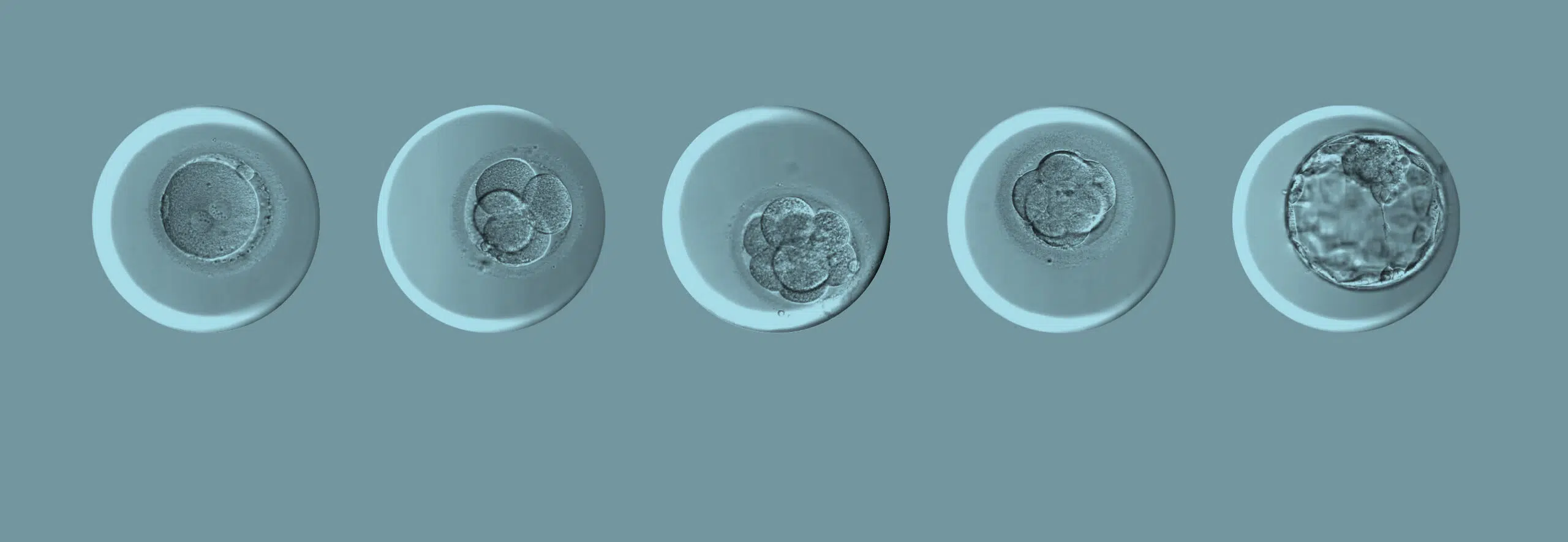
Microscope images showing embryos developing to the blastocyst stage during IVF.

Making sense of embryo grading

If you are going through IVF, you will know that every update from the laboratory feels important. When the embryologist calls to tell you how your embryos are developing, they may mention terms such as blastocyst grading, embryo grading chart, or refer to grade A, for example.

It is normal to wonder what these codes mean. Do they predict success? Does a higher grade mean a higher chance of pregnancy? Where does PGTA testing fit into this? 

At Ferticentro, we know how emotional this stage can be. Our team believes that information should empower you, not overwhelm you.

This article explains what embryo grading means, how it relates to success rates, and why it plays such an important role in IVF.

How embryos are created in IVF

Before we look at grading, let’s take a brief look at how embryos are formed. Understanding this process helps everything make more sense.

Step 1: Stimulating the ovaries

During the first stage of IVF, medication encourages your ovaries to produce multiple follicles — small fluid-filled sacs that each contain an immature egg. The goal is to help several eggs mature at once, rather than the single egg released in a natural cycle. You’ll have regular scans and blood tests so your doctor can track follicle growth and hormone levels.

If you’d like to learn more about IVF, read our Beginner’s Guide here. 

Step 2: Collecting the eggs

When the follicles reach the right size, your doctor performs a short procedure to collect the eggs. It usually takes about 15 minutes and happens under light sedation. In the laboratory, embryologists examine the fluid from each follicle, retrieve the eggs, and place them in a warm solution that mimics the conditions inside your body.

Step 3: Fertilisation

There are two main ways eggs are fertilised:

  • Conventional IVF: A sperm sample is treated and optimised in the lab, in order to select the strongest, most motile spermatozoa. Eggs are then placed overnight with a sample of more than 100,000 spermatozoa in a special culture medium, to enable fertilisation.
  • ICSI (intracytoplasmic sperm injection): embryologists inject a single, carefully chosen sperm directly into each mature egg. It allows for the successful fertilisation of eggs even when the sperm quality, count, or motility is extremely low.

Step 4: Embryo culture and monitoring

Once fertilised, embryos grow in special incubators that control temperature, oxygen, and humidity. Modern time-lapse incubators take continuous photographs of each embryo so embryologists can watch development without disturbing them.

Step 5: Embryo staging

Embryologists check the embryos every day and describe them by stage.

The different stages of embryos by day

Day 1: Zygote

Two small circles (pronuclei) appear, showing the egg and sperm have joined. Below is an image of a fertilised egg on day 1 of development.

Microscopic image of a fertilised human egg on day 1, showing two pronuclei inside the cell before it begins dividing.

Day 2: Cleavage

The embryo divides into two to four cells. Below is an image of a day 2 human embryo with several early cells visible.

Microscopic image of a day 2 human embryo with several early cells visible as it begins cleavage division.

Day 3: Cleavage

Now around eight cells; embryologists look at size and shape. Below is an image of a day 3 human embryo with multiple cells.

Microscopic image of a day 3 human embryo with multiple cells clustered together during early development.

Day 4: Morula

The cells compact into a dense ball.

Day 5-6: Blastocyst

A fluid cavity forms, and two structures appear – the inner cell mass, which becomes the baby, and the trophectoderm, which becomes the placenta. Below is an image of a day 5 or 6 human blastocyst.

Microscopic image of a day 5 human blastocyst with a fluid-filled cavity and a dense cluster of cells on one side.

When an embryo reaches the blastocyst stage, it is ready to be assessed using a blastocyst grading system (also known as embryo grading).

What embryo grading means

Embryo grading is the way embryologists record what they see under the microscope. It helps describe how well an embryo has developed by the time it becomes a blastocyst.

Think of it as a detailed progress report. Grading helps decide which embryo to transfer first, freeze for later use, or test genetically, but it cannot guarantee which one will result in a pregnancy.

Embryo grading systems

Different clinics use different grading systems. The most widely used internationally is the Gardner and Schoolcraft blastocyst grading system, while Ferticentro follows the ASEBIR embryo grading system, used across Spain and Portugal.

Both systems classify embryos based on a careful assessment of three key factors:

  • the appearance of the inner cell mass (the cells that will form the baby)
  • the development of the trophectoderm (the cells that will form the placenta), and
  • the level of blastocyst expansion.

How ASEBIR grades are decided

ASEBIR grades embryos from A to D based on a careful assessment of three key factors:

  1. Inner cell mass (ICM) – the group of cells that will become the baby.
  2. Trophectoderm (TE) – the outer layer that forms the placenta.
  3. Blastocyst expansion – how much the embryo has expanded in preparation for implantation.

Each feature is graded from A (best) to D (lowest).

Feature A B C D
Inner cell mass Large, tightly packed Slightly smaller or less compact Few cells, uneven Very few cells, or with signs of degeneration
Trophectoderm Many even cells forming a clear layer Slightly uneven Sparse cells Very few or thin layer, or with signs of degeneration
Blastocyst expansion Fully expanded, shell thinning Partly expanded Early expansion Minimal or no expansion


For example, if an embryo is described as expanded blastocyst – inner cell mass (ICM) graded A, trophectoderm (TE) graded B, on your report you will see Grade AThis means the embryo has expanded well, the group of cells that will form the baby (ICM) looks excellent, and the outer layer that will form the placenta (TE) looks good too.

The Gardner blastocyst grading system: what 4AA, 5AA and 6AA embryos mean

Many clinics, especially outside Spain and Portugal, use a numbered system (the Gardner and Schoolcraft grading system) to describe the blastocyst stage. In this approach, the number shows how expanded the embryo is, while the two letters describe the quality of its main structures:

  • The number refers the to the blastocyst stage (expansion)
  • The first letter refers to the inner cell mass (ICM) — the cluster of cells that will become the baby.
  • The second letter refers to the trophectoderm (TE) — the outer layer of cells that will form the placenta.

Here’s how some of the most common grades are described:

  • A 4AA embryo is a fully expanded blastocyst with excellent inner cell mass and trophectoderm.
  • A 5AA embryo is a hatching blastocyst, meaning it’s beginning to emerge from its shell, also with excellent cell quality.
  • A 6AA embryo is a fully hatched blastocyst that has completely broken free from its shell and shows excellent quality in both the inner cell mass and trophectoderm.

Not all embryos will have “AA” grades, and that’s perfectly normal.

  • A 4AB embryo, for example, has an excellent inner cell mass but a slightly less compact or uneven trophectoderm.
  • A 4BB embryo has good quality in both areas — not perfect under the microscope, but still with strong potential for implantation and pregnancy.
  • Even embryos graded 4BC, 4CB, or 4CC can result in healthy births, though their implantation rates tend to be lower.

What matters most is not perfection under the microscope, but whether the embryo is capable of continuing normal development. Many healthy babies have been born from embryos that were graded as “average” or even “lower quality.”

Who grades embryos?

Embryologist in a laboratory examining embryos under a microscope during the IVF process.

Behind every grading system is a team of highly skilled embryologists who dedicate their expertise to every embryo they assess. As Dr Barauna explains:

“For all of these procedures to be performed safely and effectively, having a highly trained and experienced laboratory team is essential. Skilled embryologists are crucial to ensuring accurate embryo grading, performing safe biopsies when indicated, and integrating laboratory findings with clinical decision-making in a way that truly supports patients’ success.”


At Ferticentro, we combine this human expertise with cutting-edge technology. We strongly believe in combining science with innovation. Alongside the expertise of our embryologists, we use an artificial intelligence system that supports decision-making.

“After the embryologist performs the grading, the AI tool assigns a score from 0 to 10, based on data collected over five days of embryo development. This helps us select the embryo with the highest implantation potential, offering patients the best possible chance of success.”


This approach ensures that every embryo is assessed twice: once by an experienced embryologist using the ASEBIR system and once by AI software that analyses thousands of development patterns. Together, they make embryo selection as objective and reliable as possible.

Embryo grading and success rates

Embryo grading gives us useful clues, but it is not an exact science. Each grading system expresses quality a little differently.

The most widely used internationally is the Gardner and Schoolcraft blastocyst grading system, while Ferticentro follows the ASEBIR embryo grading system, used across Spain and Portugal. Both approaches aim to identify embryos with the highest chance of implantation.

Approximate success rates using the ASEBIR system

The ASEBIR embryo grading system, used at Ferticentro, classifies embryos from A to D based on three key features: the inner cell mass, the trophectoderm, and the level of blastocyst expansion.

  • Grade A: Excellent morphology, symmetrical cells, strong potential.
  • Grade B: Good morphology with minor irregularities, still high implantation potential.
  • Grade C: Moderate quality, with some unevenness in structure or development.
  • Grade D: Lower quality; implantation still possible, though less likely.

Research shows that implantation rates under the ASEBIR system follow a similar pattern to Gardner:

  • A and B grades have the best potential for pregnancy,
  • C grades can still lead to healthy babies, and
  • D grades have lower implantation rates but are not excluded.

Given the low success rates associated with grade D embryos, at Ferticentro these embryos are neither cryopreserved nor transferred.

Approximate success rates using the ASEBIR system:

ASEBIR Approx. implantation rate What it means for patients
A 50%-65% Highest chance of implantation
B 45-50% Very good potential
C 35-40% Moderate potential 

Approximate success rates using the Gardner system

Studies comparing embryo grades and implantation outcomes show a general pattern:

Embryo grade Approx. implantation rate What it means for patients
4AA / 5AA  55 – 65 % Highest chance of implantation
4AB / 5AB  45 – 55 % Very good potential
4BB / 5BB  35 – 45 % Moderate potential
Lower grades 20 – 30 % Still possible – never zero


These figures illustrate trends, not guarantees. Many successful pregnancies come from embryos that looked “average” under the microscope.

Other factors affecting success rates

Pregnancy success also depends on several other factors, such as:

  • The woman’s age and egg quality – egg health naturally declines with age, affecting embryo development.
  • The quality of the sperm – sperm motility, shape, and DNA integrity all influence fertilisation and embryo growth.
  • The uterine environment – a healthy, receptive endometrium is essential for implantation.
  • Chance – because even the best embryo sometimes does not implant, and medicine can’t explain every outcome.

What both systems have in common is that they are probabilistic, they estimate likelihood, not outcome. Every embryo is unique, and every pregnancy depends on many factors beyond what can be seen under the microscope.

Because embryo grading focuses on what embryologists can see under the microscope, it does not reveal the genetic health of an embryo.

Two embryos might look identical in quality, yet one could be chromosomally normal and the other not.

For this reason, many IVF patients, especially those over 35 or with a history of miscarriage — choose to combine morphological grading with PGT-A (preimplantation genetic testing for aneuploidy). Together, these approaches provide a clearer, more complete picture of which embryos have the highest chance of developing into a healthy pregnancy.

According to Dr Bruno Barauna, Laboratory Quality Director and Embryologist at Ferticentro:


Although this grading does not reveal the genetic health of an embryo, it gives us valuable clues about which embryos may have a higher chance of being chromosomally normal (euploid) and which may have better implantation potential. Of course, as we are working with human biology, there are no guarantees – these are probabilities based on scientific studies to date.

How embryo grading works with PGT-A

PGT-A (preimplantation genetic testing for aneuploidy) is an optional test that analyses a few cells from the outer layer of the embryo (the trophectoderm) to check whether the embryo has the correct number of chromosomes.

Embryo grading and PGT-A look at two different aspects of embryo health. Grading focuses on how the embryo looks and develops, while PGT-A focuses on its genetic makeup. Dr Barauna explains:

“Generally, embryos with higher morphological quality tend to have a higher probability of being euploid compared to those of lower quality.”


He adds that this is about likelihood, not certainty:

“However, this is not a guarantee – it remains a matter of probability.”


Dr Barauna adds that age also plays a key role in this equation:

“Another major factor influencing euploidy rates is oocyte age, which is directly linked to egg quality. The quality of oocytes declines significantly after the age of 35 and even more after 40.”


For this reason, Ferticentro encourages patients to see grading and PGT-A as complementary, not competing, tools. Dr Barauna says:

“While embryo morphology gives valuable information, it cannot on its own determine whether an embryo is chromosomally normal,” says “PGT-A testing can therefore be an important complementary tool, even for embryos that look less ideal under the microscope, as they can still be euploid.”


In simple terms, grading shows how well an embryo looks and grows, while PGT-A reveals whether it carries the right genetic material. Used together, they provide the clearest picture of embryo potential.

What happens next after embryo grading

Fertility specialist meeting with a couple to discuss the next steps after embryo grading.

Once embryos have been graded, your medical team discusses next steps with you. Options may include:

  • Fresh embryo transfer – usually on day 5 or 6.
  • Freezing (vitrification) – embryos are stored for future cycles.
  • PGT-A testing – in this case, embryos are also frozen. A small sample of cells is taken from the trophectoderm (the layer that forms the placenta) and sent for genetic analysis, while the embryos themselves are cryopreserved. Once the results are ready, a chromosomally normal (euploid) embryo can be thawed and transferred in a later cycle. For more information, read our guide on embryo screening here.

Whichever route you choose, your doctor will explain the reasoning, potential outcomes, and support available at each stage.

Frequently asked questions

Does embryo grading matter?
Yes. Embryo grading gives important clues about implantation potential. However, even lower-graded embryos can result in healthy babies, so grading should never be seen as a guarantee.

Does embryo grading matter if euploid?
It still matters. A euploid embryo (chromosomally normal) may look different under the microscope. Morphology helps predict which euploid embryo has the best chance of attaching to the womb.

Does embryo grading matter with PGT-A?
Yes. PGT-A provides genetic information, while grading provides visual and developmental information. Together, they help doctors decide which embryo to transfer first.

How are embryos graded?
Embryologists examine the blastocyst under a high-powered microscope. They look at three things: the inner cell mass (which becomes the baby), the trophectoderm (which becomes the placenta), and the level of expansion. Each feature is graded from A to D.

How does embryo grading work?
It’s a detailed observation process. Embryologists use international guidelines such as ASEBIR to describe embryo quality clearly and consistently.

What are the embryo grades?
Grades run from A (best) to D (lower quality). Many clinics also use numbers like 4AA or 5AA to show expansion and quality.

What does the number mean in embryo grading?
The number shows how expanded the blastocyst is:

1 = early blastocyst
2 = blastocyst
3 = full blastocyst
4 = expanded blastocyst
5 = hatching blastocyst
6 = hatched blastocyst

The letters describe the quality of the inner cell mass and trophectoderm.

When are embryos graded?
Embryos are usually graded on day 5 or 6 after fertilisation, when they reach the blastocyst stage. Some clinics also record early-stage observations on days 2 and 3.

What is a 4AA embryo?
A 4AA embryo is a fully expanded blastocyst with excellent inner cell mass and trophectoderm. It’s considered one of the strongest grades.

What is a 5AA embryo?
A 5AA embryo is beginning to hatch from its shell and has excellent cell quality. It’s often chosen first for transfer or freezing.

Can a lower-graded embryo become a baby?
Yes. Many pregnancies come from embryos graded C, or D. Grading indicates likelihood, not destiny.

Can embryo grading predict miscarriage?
No. Miscarriage risk depends mainly on genetic health and maternal factors. PGT-A provides more insight into chromosomal issues.

What happens if none of my embryos reach blastocyst?
It can feel disappointing, but it doesn’t mean you can’t get pregnant. Your doctor will review stimulation, egg quality, and lab conditions to adjust your next cycle.

Do frozen embryos have lower success rates?
Not anymore. With modern vitrification, frozen embryos have almost the same success rates as fresh ones once thawed.

Does age affect embryo grading?
Yes. Egg quality declines with age, making it more common for embryos to show uneven cell structure or slower growth after 35.

Is AI replacing embryologists?
No. AI supports embryologists by analysing patterns too small for the human eye, but final decisions are always made by experts.

Contact Ferticentro to learn more about embryo grading and IVF

At Ferticentro, every embryo is carefully evaluated using the most advanced laboratory methods and guided by decades of clinical experience. Whether you’re preparing for your first IVF cycle or considering PGT-A testing, our team will explain every step clearly so you can make informed, confident choices.

Contact our team today to learn more about embryo grading, PGT-A, and the personalised treatment options available to you.